Tuesday, May 06, 2014

Eldridge Park


HISTORY OF TIOGA, CHEMUNG, TOMPKINS & SCHUYLER COUNTIES, NEW YORK by Everts & Ensign, Philadelphia, 1879.

"The passenger on the Erie Railroad, as he leaves Elmira for the west, passes, as he emerges into the open country, a miniature lake, a velvety lawn, with statues, fountains, magnificent drives, neat buildings and ponds. To his inquiry, reply is made that this is Eldridge Park.

The drive to the park is through a willow-bordered avenue leading up to a broad English gateway, with its gate open; no hostile warder warning one away from its loveliness.


Passing through this gateway, we see just in front, under the shadow of a large tree, three mounds surrounding a jetting fountain. On two of these mounds stand white statues of the only two seasons known in this climate, and on the third the figure of a deer, which stands as if ready to seek freedom beyond the inclosure.


 Before us is the circular lake, of about fifteen acres in extent, encircled by a necklace of willow-trees.


Around this is a splendid drive, while right and left wind roads in most enticing curves, and views of beauty startle the eye at every step. Turning on the firm gravel to the left, we drive past a boat lying close to the beach, where the lapping waves make a low and peaceful murmur, and delightful vistas are just through the trees, . . .


while opposite is the statue of Andromeda, the daughter of Cepheus, king of Ethiopia; her mother, Cassiope, boasted of beauty superior to the Nereids. As a punishment for such presumption, Andromeda was chained to a rock in the sea, to be devoured by a sea monster. She was rescued by Perseus, who, after a desperate conflict, slew the monster, and claimed her as his bride. This is a fine copy of a statue by Lawrence McDonald, and which belongs to Queen Victoria. It adorns the Queen’s palace, at Osborne, Isle of Wight.

 Rounding the delightful curves and viewing the slopes, skirted by emerald escarpments, whence shoot at every turn sweet surprises, we pass the bowed form of another statue, "Contemplation," who, with pensive head, seems to review the long past.


As we reach the top of the plateau we gaze off over a delightful vista of lake and trees, of flowery nooks, and white, gleaming statues, sparkling fountains, wild dells, beds of flowers, stately trees, and delightful arbors, and a paradise it seems before us; beyond is Sabrina, . . .


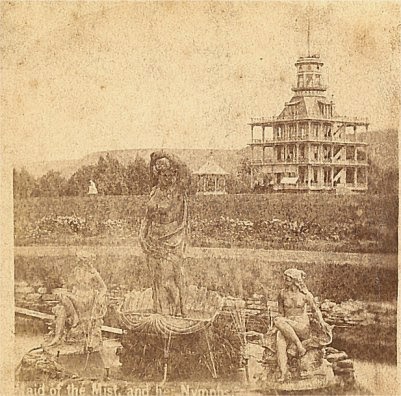
 . . . and over the trees the lake; around us a spacious lawn inclosing another basin, where, as if floating in her boat of shells, stands the "Maid of the Mist," just risen from the sea; a veil of thinnest gauze, air woven from the myriad drops that shoot upwards around her, half-hiding her beautiful form. As we turn, a rainbow kindles the mist, as if Iris herself was hiding there, and the maid is transformed into some aerial being.


"Eldridge Park, from its natural advantages, and from the munificence and taste of its owner and projector from whom it gets its name, has become one of the most worthy objects for the observation of the lover of what is beautiful that exists in the country. It is situated in the immediate vicinity of the city of Elmira, Chemung Co., N.Y., and is admirably adapted by nature for the purpose to which it has been put. It covers in extent about one hundred acres, its chief feature being a lake, circular in shape, of about fifteen acres. Around this the surface of the land is so broken that drives and winding walks laid out with great skill and taste, make the extent of the Park seem indefinite. The art of landscape gardening has been applied with admirable judgement at every spot, and at every turn in the road or walk the spectator is surprised by charming and novel effects, produced with no apparent effort or change to the natural look of the scene. Almost every variety of scenery is to be observed, from the calm and placid beauty of the lake, set like a diamond in the midst of the emerald bluffs, to the rugged and uncared-for picturesqueness of a native forest.

Scattered here and thereat available and suitable points, are various pieces of statuary. As you enter the broad gateway from the city, the first that strikes your eye are the figures of winter and summer, and a deer, surmounting three distinct mounds that partially surround a fountain.


Proceeding along the drive that skirts the borders of the lake is to be perceived, set very appropriately on some rocks a few rods from the shore, the statue of the ill-fated Andromeda.


To the left a miniature lake, artificially set, is the statue of Sabrina, the nymph of the Severn: high on a bluff beyond, the bronze figure of an Indian and his dog. 


Following the road to the south and eat on an elevated plateau, we see successively the statues of Contemplation,


Flora,


and the Maid of the Mist, the latter so exquisitely arranged that on a sunny day she seems surrounded by both the spray from the fountain and bits of rainbow.

Coming back to the level drive around the lake, the trout ponds are soon reached, and a spring of sulphur water.

Still further around and turning north from the drive, situated in a grove of trees of several varieties, and in a natural amphitheatre, around which the carriage-way leads, is the Chapel or Tabernacle, fitted up with a pulpit and rustic seats, where every pleasant Sunday, thousands from all about the neighbourhood gather to hear services conducted by some clergyman of the city. A fine brass band furnishes the instrumental music on these occasions. Within the pulpit, or open, covered and highly ornamented stand for speakers, is placed a statue of an angel kneeling, and with arms and wings folded. It adds much to the impressive beauty of the spot. 


Returning to the lake is passed on of the finest figures on the grounds, called Eva.


Through the summer season, Eldridge Park is the favourite resort of people from everywhere, who carry away from it memories that will not soon die.
 
Throught he property of a private person, Dr. Edwin Eldridge, of Elmira, it is for  the benefit of the public, and will be a donation to the city of which it forms one of the most notable features. Constant improvements and additions are being added to it in every shape to make it year by year one of the loveliest spots on the face of the earth.

Stereoscopic Views of all points if interest in the above Park, and also complete sets of WATKINS and HAVANA GLEN VIEWS constantly on hand and for sale by J. E. Larkin,

118 Water St, Elmira, N.Y.

Neptune


American Girl

http://www.stargazette.com/article/20140506/NEWS01/305060028/Vintage-Elmira-Eldridge-Park-through-years

http://www.elmiratelegram.com/index.php?/topic/121-pics-from-eldridge-park/


http://www.stargazette.com/article/20140411/NEWS01/304110022/

http://www.joycetice.com/postcard/eldridge1.htm


Monday, March 17, 2014

British Constructivists

Terry Pope
Michael Kidner
Malcolm Hughes
Gillian Wise Ciobotaru
Jean Spencer

"At one level this tradition seems to satisfy a native love of orderliness and restraint. Spare, disciplined and systematic, it inclines to tightness and bland self-sufficiency, but, at its best, carries unmistakable authority, concentrates looking and can excite." Frances Spalding. "British Art Since 1900." 1986 Thames & Hudson. London.

Tuesday, December 03, 2013

Friday, October 04, 2013

Time Life Library of Art

"The World of Watteau",
"The World of Giotto",
"The World of Bernini",
"The World of Velazquez",
"The World of Whistler",
"The World of Marcel Duchamp",
"The World of Bruegel",
"The World of Matisse",
"The World of Picasso",
"The World of Vermeer",
"The World of Rubens",
"The World of Cezanne",
"The World of Leonardo",
"The World of Copley",
"The World of Rembrandt",
"The World of Durer",
"The World of Van Gogh",
"The World of Turner",
"The World of Delacroix",
"The World of Titian",
"The World of Goya",
"The World of Manet",
"The World of Winslow Homer",
"The World of Rodin",
"The World of Michelangelo",
"The World of Gainsborough",
"American Painting, 1900 - 1970"
"Seven Centuries of Art, Survey and Index".

Saturday, September 28, 2013

Why Are Some People Better at Drawing than Others?

http://www.livescience.com/19878-drawing-ability.html

Saturday, September 21, 2013


And so another year of misery and confusion begins, I have decided to become the nosiest fucker this year . . . .

I would love to know who created the work in the Rootstin Hopkins Square - do they keep a register of all the work that has been displayed there ? . . .

If not, why not ? And if they do, why is it not obvious . . . .

the thing is even when arrangements stop being mysterious - it remains mysterious why they were such a mystery in the first place . . . . .

Friday, July 26, 2013

the at object as

event - destination . . .

Sunday, April 14, 2013

Tuesday, April 09, 2013

Regent Palace Hotel 1912 - 2009

The Regent Palace Hotel, another J Lyons hotel in central London. Built in the Beaux Arts style and opened in 1915.

The building is a steel-framed structure, faced externally with glazed terra-cotta, the roof being covered with green slates. No less than 6000 tons of steelwork were required for the structure. There are nine floors above ground level, with a lower ground floor, basement and sub-basement.

The main entrance is at the apex facing towards Piccadilly Circus.


Here, one once entered through a vestibule into a circular lounge, lined with marble and having a richly embellished ceiling in the form of a shallow dome.

"Vestibule"


"Entrance Hall"


"The Reception Hall, Regent Palace Hotel"


The vestibule opened into the reception hall, on the one side of which was a staff counter and office, while on the other, was a marble staircase and three passenger lifts serving the various floors.

Beyond, entered through the large swing doors, was the Rotunda Court. It had, over the centre, a large dome-light filled with stained and leaded glass and was seated with chairs and tables, which were chiefly occupied for afternoon tea.

"Rotunda Court"


Opening out of the Rotunda Court was the Louis XVI Restaurant. The walls were of a light tone, with dark brown hangings to the windows.

"Louis XVI Restaurant"


From one side of the Rotunda court access was gained to a corridor off which opened the general writing-room, and the Ladies’ writing-room, and at this point also were stairs leading up to the bedroom floors and down to the apartments on the lower ground floor, which include an immense grill-room, a smoking and reading room, a small palm court, and a billiard room.

"Grill Room"
"Grill Room"
Winter Garden"
"Drawing Room"


In the basement are the kitchen and kindred offices, and in the sub-basement the heating, ventilating, and power plant.

"Kitchen, Regent Palace Hotel Piccadilly."


From the first floor upwards, the whole of the hotel was occupied by bedrooms, sitting-rooms and bathrooms.


In 1934, the ‘Chez Cup, Bar’ under the entrance rotunda, was created in 1934 out of the former billiard room, and has been recreated in 2010 from the original architectural drawings.


Strand Palace Hotel

The site of the Strand Palace Hotel

Rectory of St Clement Danes,

House built on site by Thomas Palmer (died 1553)

1561 House extended

Extended by William Cecil [1520 - 1598]

1571 Cecil was created Lord Burghley, this London seat becomes known as Burghley House.

"It was a symmetrical double-courtyard brick house of three storeys, with four-storey corner turrets. A central entrance led from The Strand into the front court. At its garden front, with a central bay window and corner turrets, the house looked over gardens on grounds purchased from the Earl of Bedford and the earl's fields of Covent Garden beyond. The garden included a mount with a spiralling path to its top, a paved tennis court, a bowling alley and an orchard."

1598 The house becomes the residence of Burghley's elder son Thomas Cecil.

1605 Thomas Cecil created 1st Earl of Exeter.

His younger brotherRobert Cecil, 1st Earl of Salisbury, builds Salisbury House on the opposite side of the Strand.

1676 House converted into/demolished and replaced by Exeter Exchange


1817 Waterloo Bridge opened.

1829 Exeter Exchange Demolished

1831 Exeter Hall opens.

1907 Exeter Hall Demolished

1907. Strand Hotel Limited was incorporated on 31 October with some 4,000 shareholders. Created by the Salmon & Gluckstein families, it was established to fund the building of the Strand Palace Hotel.


1909 Strand Palace Hotel opens.


1922. J Lyons &Co acquired shares in this enterprise and also bought the adjoining Haxells family hotel in order to expand and improve the Strand hotel.

1928. After extensive redevelopment, the hotel became an art deco showcase, and reopened in  boasting 980 bedrooms.


The rear of the property was occupied by the Winter Garden Restaurant.The Winter Garden restaurant had a large dome ceiling and could seat over 500 guests, which were served by over 100 staff.


Due to its large number of bedrooms, the hotel became popular with the American forces before they were sent into action. Indeed, the hotel was in fact commissioned as an official U.S rest and recuperation residence.


The post-war era saw the Strand Palace Hotel implement a number of improvements. With the introduction of private bathrooms in all guest rooms in 1958, reducing the number of rooms at the hotel to 786. The increased number of bathroom facilities meant oil-fired boilers had to be installed to cope with the demand for hot water.

1968. the front hall and ground floor restaurants, including the Winter Garden, were redesigned, and the first computerised billing system in London was installed.
The revolving doors designed by Oliver P. Bernard were removed in this redesign, but were of such fine quality and historic interest that curators at the Victoria and Albert Museum requested them for their collection.The doors were exhibited in 2003, in the museum's major exhibition 'Art Deco: 1910-1939' .

1976. Forte bought the lease for the Strand Palace Hotel from the Lyons Hotel Group.

1985. An in depth refurbishment was undertaken on all floors of the new hotel and this included new furniture, new bathrooms and a redecoration of the bedrooms.

2006. London and Regional Properties' took over the hotel.

Sunday, April 07, 2013

Chris Killip

Aricle in the Telegraph Magazine, on Chris Killpip, photographer due to the upcoming show at the Photographers Gallery London

This image particularly intrigued me . . .  in the magazine it's titled "housing and Swan Hunter's Shipyard. Wallesend, 1975.


I noticed the street sign "Gerald Street".

Turns out to be the birthplace of Sting in 1951.

"Leslie Street together with neighbouring streets, Hunter Street, Davis Street, Gerald Street and Camp Road are now demolished allowing for the excavations of the Roman Fort Segedunum.


"Eventually, in 1884, the whole fort disappeared under terraced housing. . . . . North Tyneside Council provided accommodation in the newly built Battle Hill Estate for the owners of all the houses demolished."


"Segedunum: The 'most excavated' fort on Hadrian's Wall"


Monday, March 25, 2013

Until it all becomes just a howl in the dark . . . .

Tuesday, February 26, 2013

the secret life of objects

http://www.rouge.com.au/13/secret.html

Saturday, February 02, 2013

The house on Findlay Avenue


Continuing my derive around New York, in this case the Bronx, and more specifically Morrisiania.

The above image is from this large map of the Bronx of 1897. from here

No idea what the building that stands there now is called.


from here

There is a "Daughters of Jacob Geriatric Care Center" across the road connected to this building with a walk way over the road.

While thebuilding itself seems to be the "Church Alive Community Church"

What was the building that stood there before called ?

"The imposing building on a hill at East 167th Street and Findlay Avenue is the Daughters of Jacob Geriatric Center, mostly built in 1920. Its 8 wings in a spoke arrangement are impressive seen from the air."


Lewis Morris<
/a>

Morrisania Air Rights


http://128.59.96.140/bronxbeat09-bronx/www/story.asp?id=377

http://www.lehman.edu/vpadvance/artgallery/publicart/neighborhoods/morrisania.html

Lewis Morris 1 2 3 & 4

"The map of Morrisania was vastly different in 1887 than it is in 2011.

Before the current complement of streets was laid out along a rough grid pattern, the William H. Morris holdings were dominated by the New York Driving Club, basically a horse track.

Equestrian culture in Morrisania went back to the 1750s, when the level land was used by General Staats Long Morris as a race course.

William Morris rented space to a Dater Brothers in 1871, who built a race track that lasted briefly. The NY Driving Club opened here the following year, and its trotting track, FLEETWOOD PARK , boasted an exclusive membership that included William K. Vanderbilt, William Rockefeller, and Leonard Jerome, whose own track in Kingsbridge was home to the Belmont Stakes.


Trotting at Fleetwood Park, Morrisania 1872 from here


The Driving Park and Fleetwood Park closed in 1898, and development soon erased any trace of any former equestrian use."

http://forgotten-ny.com/2011/01/morrisania-bronx/


Could it be . . .

"The William H. Morris Mansion

Nothing but a foundation remains to mark the site of the solid William H. Morris Mansion, whose stone walls stood ever since 1816 on the high ground at 167th street and Teller Avenue, overlooking the peaceful valley where once flowed the tortuous Mill Brook. To the east was the old Morrisania Station of the Harlem Railroad, while toward the south lay the broad acres of that well-known rendezvous of all lovers of the turf, Fleetwood Park.

A remarkable phenomenon presented itself in the hall of this great abode, there were no stairs! Broad and commodious as the hallway was, and extending from side to side, it was not until a small door was opened, apparently leading into a small side room, that the main stairway was disclosed, wending its winding way above. The owner evidently took no chances with possible nocturnal visitors of the early days.

Old Mansions Of The West Bronx
by Randall Comfort
"

Valentine's Manual of Old New York No.7 New Series 1923, Edited by Henry Collins Brown Copyright: 1922 Henry Collins Brown

Lewis Morris, signer of the Declaration of Independence, was the eldest son of Judge Lewis Morris (see . . . ), born at Morrisania in 1726, died in 1798; three of his sons served with distinction in the army and received the thanks of Congress, of whom Lewis was aide to Sullivan, and afterwards to Greene: James, the fourth son, married Helen Van Cortlandt, daughter of Augustus Van Cortlandt, and erected the great, square, handsome dwelling which stands upon an eminence near Fleetwood Park, the present residence of William H. Morris. The Morrises were all men of splendid physique.